Summary
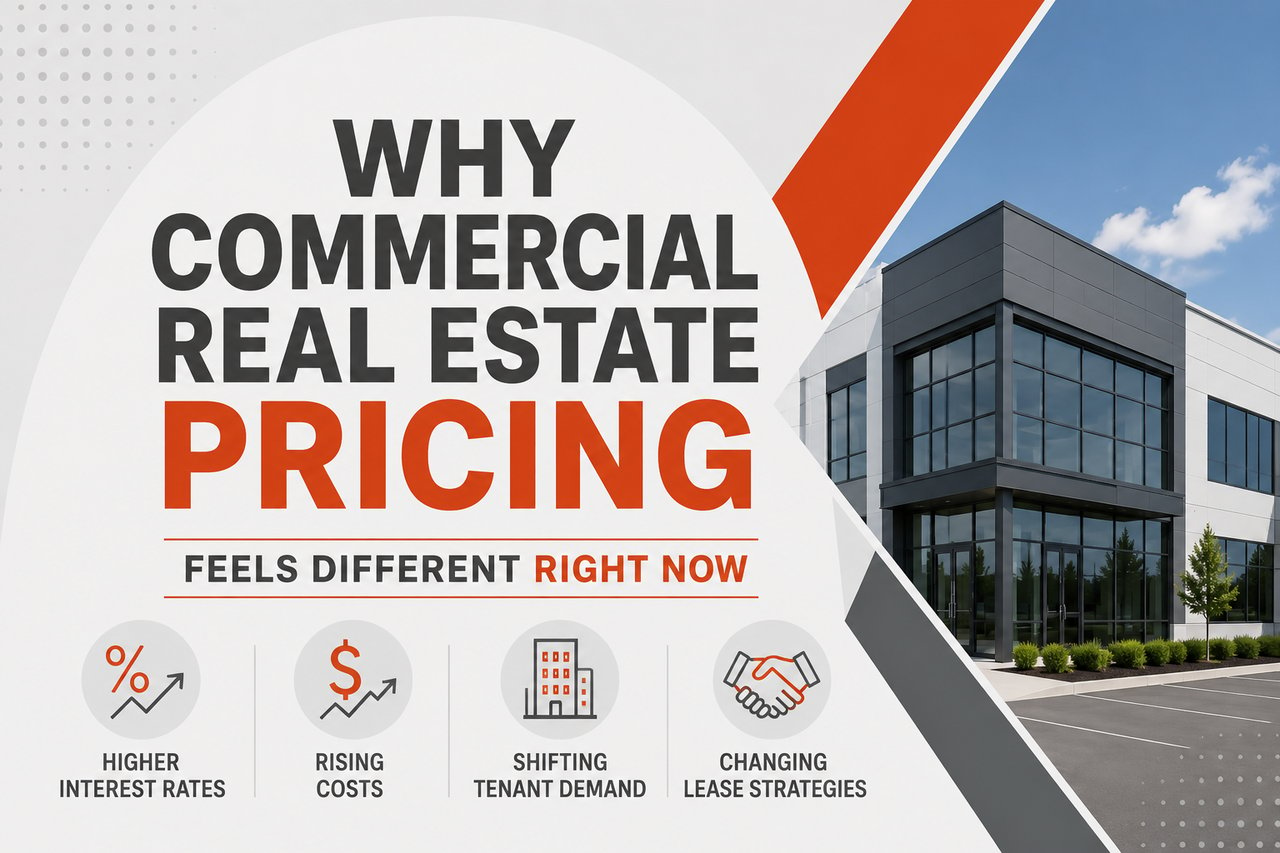
Commercial real estate pricing feels different right now because the market has changed across several major areas at once. Higher interest rates, rising operating costs, more cautious lenders, increased construction expenses, and shifting tenant demand have all affected how commercial properties are valued.
For buyers, the question is no longer only what a property was worth a few years ago. It is what the property’s income can support in today’s financing environment. For sellers, landlords, and tenants, pricing now depends more heavily on lease structure, tenant quality, buildout costs, operating expenses, and risk.
In today’s market, commercial real estate value comes down to three core factors: income, risk, and cost.
Why Does Commercial Real Estate Pricing Feel Different Right Now?
Commercial real estate pricing feels different right now because the market is still adjusting to a new reality.
Whether you are buying, selling, leasing, or trying to understand what a property is worth, today’s numbers may not feel the same as they did a few years ago. That is not because of one single factor.
It is not just interest rates.
It is not just inflation.
It is not just COVID.
It is the combination of several major changes happening close together.
COVID changed how businesses use space. Low interest rates helped push commercial property values higher. Then interest rates increased, construction costs rose, insurance costs went up, lenders became more cautious, and tenants began evaluating space differently.
As a result, the market is still working through a reset.
Commercial Real Estate Value Starts With Income
Commercial real estate pricing is closely tied to the income a property produces.
That means value is not based only on the building itself. It is also based on the leases, tenants, rent structure, operating expenses, lease terms, and risk associated with that income.
A property with strong leases, reliable tenants, scheduled rent increases, and several years of lease term remaining is usually easier to value. A property with vacancy, short-term leases, below-market rents, or uncertain renewal prospects is harder to price.
That uncertainty affects value.
In today’s market, buyers are paying close attention to whether a property’s income actually supports the asking price.
Higher Interest Rates Changed the Math for Buyers
One of the biggest reasons commercial real estate pricing feels different today is that financing costs changed.
Most commercial real estate buyers do not purchase properties entirely in cash. They use debt. When interest rates are lower, buyers can often afford to pay more because their monthly debt payments are lower.
When interest rates are higher, the same property may no longer support the same purchase price.
That is why sellers and buyers can look at the same property very differently.
A seller may think:
“This property should be worth what it was worth a few years ago.”
A buyer may think:
“What can this property actually support today?”
Those are two very different questions.
For business owners evaluating their next move, today’s financing environment can also affect whether to buy or lease commercial space.
How Cap Rates Affect Commercial Real Estate Pricing
Cap rates are one way investors evaluate commercial real estate value. A cap rate compares a property’s net operating income to its value.
Here is a simple example.
If a commercial property produces $100,000 per year in net operating income and buyers are valuing that income at a 6% cap rate, the property would be worth about $1.67 million.
If the market now requires an 8% cap rate, that same $100,000 in income supports a value of about $1.25 million.
The building did not change.
The income did not change.
But the required return changed.
That change affects value.
This is one of the main reasons commercial real estate pricing can feel so different right now. A property can still be a good property, but it may not support the same price it did in a lower-rate environment.
Leasing Has Become a Bigger Part of the Pricing Conversation
Leasing is also playing a larger role in commercial real estate pricing.
Tenants are more careful today. They are not only asking, “What is the rent?” They are also asking, “What is the total cost of being in this space?”
That total cost may include:
-
Base rent
-
Operating expenses
-
Utilities
-
Maintenance responsibilities
-
Buildout costs
-
Parking
-
Access
-
Layout efficiency
-
Move-in timing
-
Whether the space actually works for the business
This is especially important in leases where tenants are responsible for pass-through costs, such as triple net charges in a commercial lease.
A cheaper space may not truly be cheaper if it requires major improvements or does not function well. A more expensive space may be the better overall deal if it is move-in ready, better located, or allows the tenant to open faster with fewer upfront costs.
That is why lease pricing is not always as simple as comparing one rate to another.
The structure of the lease matters. The condition of the space matters. Tenant improvement costs matter. The length and quality of the lease matter.
For a deeper breakdown of rent, expenses, and other occupancy costs, see our guide on how much it costs to lease commercial space in Alabama.
Two Similar Commercial Properties Can Have Very Different Values
Imagine two small warehouse properties.
Property A is fully leased to a stable tenant on a five-year lease with annual rent increases.
Property B is vacant, needs office updates, has some deferred maintenance, and the owner is assuming it can lease at top-of-market rent.
From the outside, those two properties may look similar.
But to a buyer, they are very different.
Property A has income.
Property B has a leasing project.
That leasing risk also depends on timing, which is why owners should understand how long it takes to lease commercial space before assuming a vacant building will produce income quickly.
That does not mean Property B is a bad opportunity. It may still be a good investment. But a buyer is going to price in the time, cost, and risk of getting the building leased.
This is why leasing and property value are so closely connected.
Why Landlords and Tenants See Pricing Differently
Landlords and tenants may feel like they are looking at the market from opposite sides.
Landlords are dealing with higher costs, including insurance, property taxes, repairs, utilities, financing, and construction expenses. Because of that, even when a tenant expects a lower lease rate, the landlord may not have as much room to reduce pricing as the tenant thinks.
At the same time, tenants are watching their own costs carefully. Many businesses are dealing with higher labor costs, equipment costs, inventory costs, financing costs, and operating expenses.
That makes lease negotiations more focused on structure.
Sometimes the rent stays firm, but the landlord offers free rent. Sometimes the tenant signs a longer lease in exchange for improvements. Sometimes the landlord helps with move-in timing. Sometimes the tenant chooses a space with higher rent because it avoids a large buildout cost.
In today’s commercial real estate market, the best deal is not always the lowest rent or the highest rent. It is the deal that actually works.
Why Old Commercial Real Estate Comps May Not Tell the Whole Story
Old sale and lease comps can still be useful, but they need context.
A sale from a few years ago may have happened in a completely different financing environment. A lease comp from before COVID may not reflect how tenants evaluate space today. A broad market headline may not apply to your specific property, tenant, location, or lease structure.
That is why commercial real estate pricing today requires more than simply looking backward.
The details matter more now.
Income matters. Lease terms matter. Tenant quality matters. Buildout costs matter. Financing matters. Operating costs matter. Realistic expectations matter.
What Actually Drives Commercial Real Estate Value Today?
Commercial real estate value today is driven by income, risk, and cost.
Income answers the question: What does the property produce?
Risk answers the question: How reliable is that income?
Cost answers the question: What will it take to finance, maintain, lease, or improve the property?
Those three factors influence how buyers, sellers, landlords, tenants, and lenders evaluate commercial real estate.
In a lower-rate environment, some pricing assumptions were easier to support. In today’s market, the numbers are under more pressure. That does not mean deals are not happening. It means pricing needs to be more realistic, better supported, and more closely tied to current market conditions.
The Main Takeaway
Commercial real estate pricing feels different right now because the market has changed.
COVID changed how businesses use space. Low interest rates pushed pricing higher. Higher rates changed what buyers can afford. Operating costs increased. Leasing demand became more selective. Lenders became more cautious. And buyers, sellers, landlords, and tenants are all adjusting.
At the end of the day, commercial real estate pricing comes down to three things:
Income: What income does the property produce?
Risk: How reliable is that income?
Cost: What will it cost to finance, maintain, lease, or improve the property?
That is why pricing feels different right now. The numbers matter more. Lease structure matters more. Tenant quality matters more. Realistic expectations matter more.
If you are trying to understand what a property may be worth, what lease rate makes sense, or how today’s market affects your next move, Right Space Commercial Real Estate can help you look at the current numbers, compare your options, and understand what is really driving value in today’s market.
Frequently Asked Questions About Commercial Real Estate Pricing
Why are commercial real estate prices changing?
Commercial real estate prices are changing because interest rates, financing costs, operating expenses, construction costs, lender requirements, and tenant demand have all shifted. These factors affect what buyers can afford, what sellers can expect, and what income a property can realistically support.
How do interest rates affect commercial real estate value?
Interest rates affect commercial real estate value by changing the cost of debt. When interest rates rise, buyers usually have higher monthly loan payments. That can reduce how much they are able to pay for a property, even if the property’s income has not changed.
Why does a higher cap rate lower property value?
A higher cap rate lowers property value because buyers are requiring a higher return on the income the property produces. For example, $100,000 in net operating income supports a higher property value at a 6% cap rate than it does at an 8% cap rate.
Are commercial real estate prices going down?
Some commercial real estate prices have adjusted, but it depends on the property type, location, tenant quality, lease terms, financing environment, and condition of the property. A well-leased property with strong income may hold value better than a vacant property with deferred maintenance or uncertain leasing prospects.
Why are lease rates not always lower when demand slows?
Lease rates are not always lower when demand slows because landlords may also be facing higher costs. Insurance, taxes, maintenance, utilities, financing, and construction expenses can limit how much flexibility a landlord has. In many cases, negotiations focus on lease structure instead of just lowering the rent.