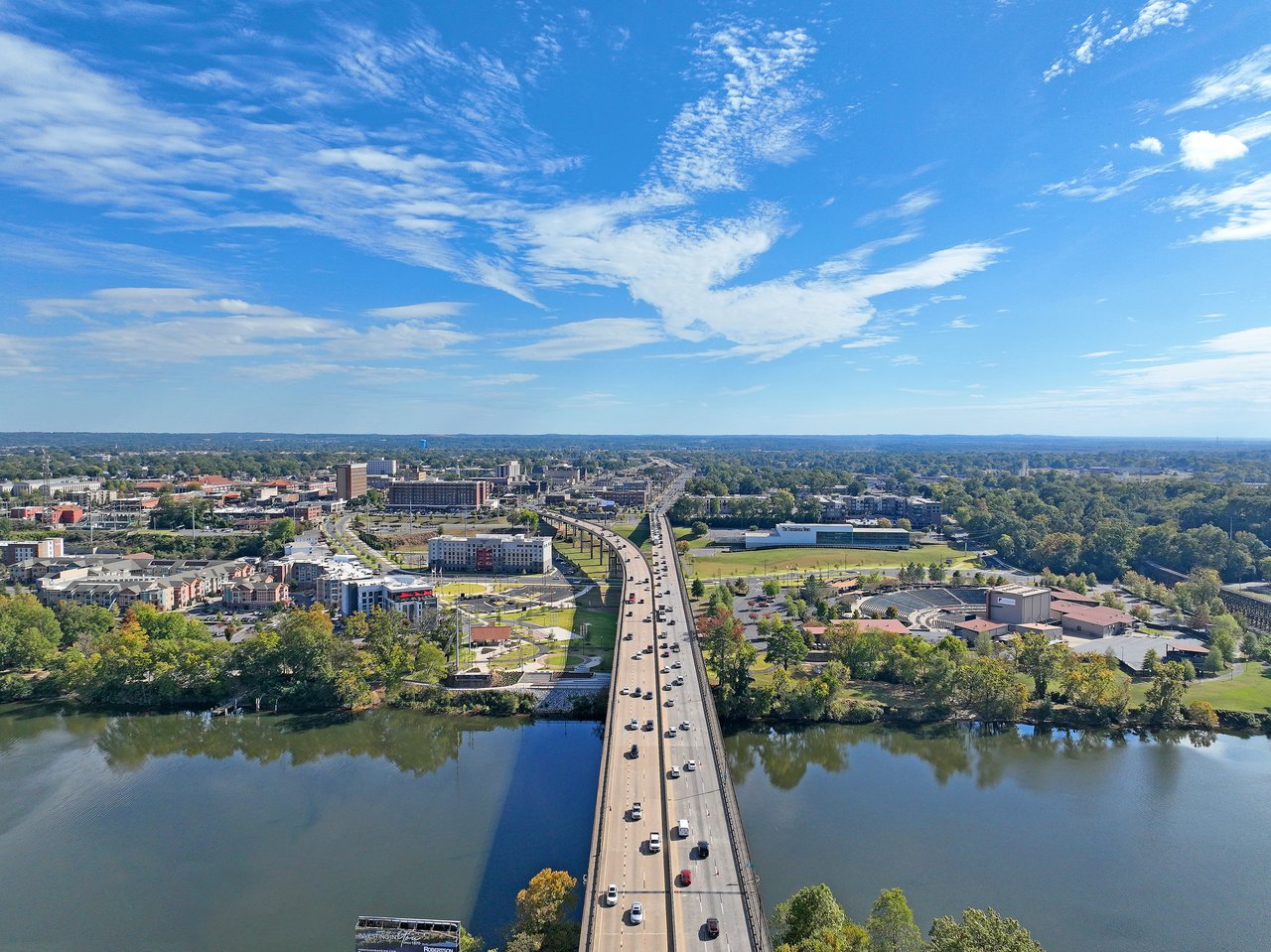
If you tried to park in the gravel lot under the old railroad trestle before a Mercedes-Benz Amphitheater show this summer, you already know the lot is gone. A chain-link fence went up in early June, the Western Riverwalk connector that used to slip underneath the trestle closed with it, and anyone walking or biking that stretch now has to double back to the west end near Oliver Lock and Dam instead. It reads like one more summer inconvenience in a town that has had a lot of them lately.
It isn't. That fence marks the start of the one project that finally stitches Tuscaloosa's three separate Riverwalk segments into a single path, something the city has been trying to do since the first stretch opened in 2002.
Three trails that have never actually met
Ask a longtime Riverwalk regular how long the trail is and you'll get three different answers, because there isn't one trail. There are three.
The original Riverwalk runs along the south bank of the Black Warrior River from the Tuscaloosa Amphitheater to Manderson Landing near the University of Alabama campus, a stretch most runners clock at 4.4 miles out and back. It's the one with the Bicentennial Statue at Manderson Landing and the loop past the Amphitheater at the west end. It has been open, in some form, for over two decades.
The Western Riverwalk is the newest piece, a roughly mile-long extension that runs from the Amphitheater area out to Oliver Lock and Dam. It opened in 2024 and, until this summer, connected to the original path by ducking under the 125-year-old wooden Mobile & Ohio Railroad trestle that crosses Jack Warner Parkway.
Then there's the Northern Riverwalk, on the opposite bank, anchored by Randall Family Park and Trailhead. That park exists because the Randall family donated 19 acres of riverfront land valued at $2.72 million to get the first phase built, then followed it with another 6.65 acres worth $1.9 million to extend it further. The park opened in January 2022 after a $5.7 million first phase, and it includes a pavilion, a playground, and a public art piece called "Dogs, dogs, dogs" by Birmingham Sculpture. It's a genuinely nice half mile of trail. It just doesn't connect to anything else.
None of these three pieces talk to each other. You can walk each one, but you can't walk from one to the next without getting in a car.
What the fence is actually for
The closure under the trestle is Phase III of the Martin Luther King Jr. Boulevard/Jack Warner Parkway Improvements Project, and it's the piece designed to fix exactly that gap. Construction started June 1, with the heavier closures, Martin Luther King Jr. Boulevard shut from just north of 6th Street to the Nick's Kids Avenue intersection, the Western Riverwalk connector sealed off, the trestle parking lot gone, taking effect June 8.
City leaders broke ground on the phase formally in mid July, with Mayor Walt Maddox calling the bridge itself a longtime psychological barrier between West Tuscaloosa and downtown. State Representative Chris England, who sits on the Tuscaloosa County Road Improvement Commission that helped fund the work, put it in more practical terms: widening the trestle brings both traffic and resources to a part of town that has gone without either for a long time. City officials have pointed out that the project also opens more than 100 acres in West Tuscaloosa for future development, which is a separate story from the trail but tells you the scope of what's actually happening under that fence.
The work itself involves widening two railroad bridge spans so trucks and emergency vehicles can pass beneath them, something the current trestle is too narrow to allow. Trains keep running the whole time. The city has priced the phase at $49 million, part of a three-phase corridor rebuild that has run to roughly $86 million total once you include the completed Phase I and Phase II work between Stillman Boulevard and Almon Avenue. City officials have called it the largest infrastructure investment in Tuscaloosa's history. The timeline is two and a half years, which puts a realistic finish somewhere in late 2028.
When it's done, the Western Riverwalk connects straight through to the original path near the Amphitheater instead of dead-ending at a fence.
The other half of the connection is already underway
The trestle isn't the only piece moving. On the north bank, Phase 2 of the Northern Riverwalk is extending the trail from its current end at Randall Family Park to a new pedestrian bridge being built as part of the McWright's Ferry Road expansion. That work was slated to break ground this spring, with the city aiming to have it finished by the end of 2026, well ahead of the trestle work on the other side of the river.
City Engineer Michael Gardiner laid out how the two projects fit together at a recent Transportation Summit. Once the trestle widening links the Western Riverwalk to the original path, and the Northern Riverwalk's pedestrian bridge links Randall Family Park to the McWright's Ferry Road extension, the two banks join at the Woolsey Finnell bridge. From there, the plan continues the Northern Riverwalk on toward Bluegrass Parkway near New Watermelon Road, reaching the lakes on the north side of town.
By Gardiner's estimate, once every piece connects, the city ends up with roughly 9.2 miles of continuous trail stretching from the Western Riverwalk Park to Bluegrass Parkway.
Here's what that looks like laid out plainly.
Segment | What exists today | What connects by 2028-2030 |
|---|---|---|
Western Riverwalk | About 1 mile, dead-ends at the trestle | Links through to the original path near the Amphitheater |
Original Riverwalk | 4.4 miles, Amphitheater to Manderson Landing | Already open, becomes the middle section |
Northern Riverwalk | 0.6 mile at Randall Family Park | Extends to McWright's Ferry Road bridge, then toward Bluegrass Parkway |
Connected total | Three separate trails, zero miles linked | Roughly 9.2 miles, one continuous path |
Right now the honest number is zero. Not one of these segments reaches another. The fence under the trestle is the ugliest looking piece of that math, but it's also the one that turns three disconnected trails into a single system.
What this actually changes for your weekend
If you use the Western Riverwalk regularly, plan on entering from the Oliver Lock and Dam end for the next couple of years, since the trestle connector and its parking lot are out for the duration. If you go to Amphitheater shows, that means no parking in the trestle lot, so build in time to find a spot elsewhere before the next concert you buy tickets for. If you're on the north side near Randall Family Park, expect the trail to keep growing this year as the McWright's Ferry Road bridge work continues, with a city target of wrapping that phase by the end of 2026.
None of this is glamorous while it's happening. Fences, detours, and a two and a half year construction window rarely are. But the alternative, three separate riverfront trails that never meet, has been the actual state of the Riverwalk since the Northern segment opened in 2022. The project underway right now is the one that changes that math for good.
West Tuscaloosa is also the part of town this project is meant to open up, both for traffic and for the roughly 100 acres city officials say the wider corridor makes usable for future development. That kind of shift, where infrastructure work reshapes what a stretch of the city can support next, is the sort of thing we track closely at Right Space Commercial, because it tends to show up in what gets built, leased, and filled a few years later. If you're watching how this corridor changes and want to talk through what it means for a specific property or a specific block, find your space.